AMD reported Tuesday night. The company beat on revenue, beat on earnings, grew data center sales 107%, and the stock fell 10%. It might have been the massive capital expenditure: $808 million against a $298 million estimate, that punished the stock.
One company investing heavily is a growth story. An entire industry investing heavily at what could be peak product prices is how every glut in history develops.
Commodity producers run the same play at the top of every cycle. Prices rise sharply, and everyone expands at once. New capacity takes years to build, so it arrives at the same time, usually at the time demand cools off. The gold miners did it in 2011, paying top dollar for development-stage projects at $1,900 gold and writing off billions when it collapsed to $1,200. The iron ore producers expanded production at $180 per ton, and their own supply helped push the price below $40. Shale producers drilled like mad at $100 oil and then regretted it when the price collapsed to $26. Container ship owners ordered record fleets in 2007, and the Baltic Dry Index (a daily shipping price index) fell 94% when the boats were delivered.
See the chart below: Each industry's capex is indexed to 100 in the year the price of its commodity peaked. Iron ore and gold follow the same pattern: spending keeps rising for one to two years past the peak in commodity pricing.
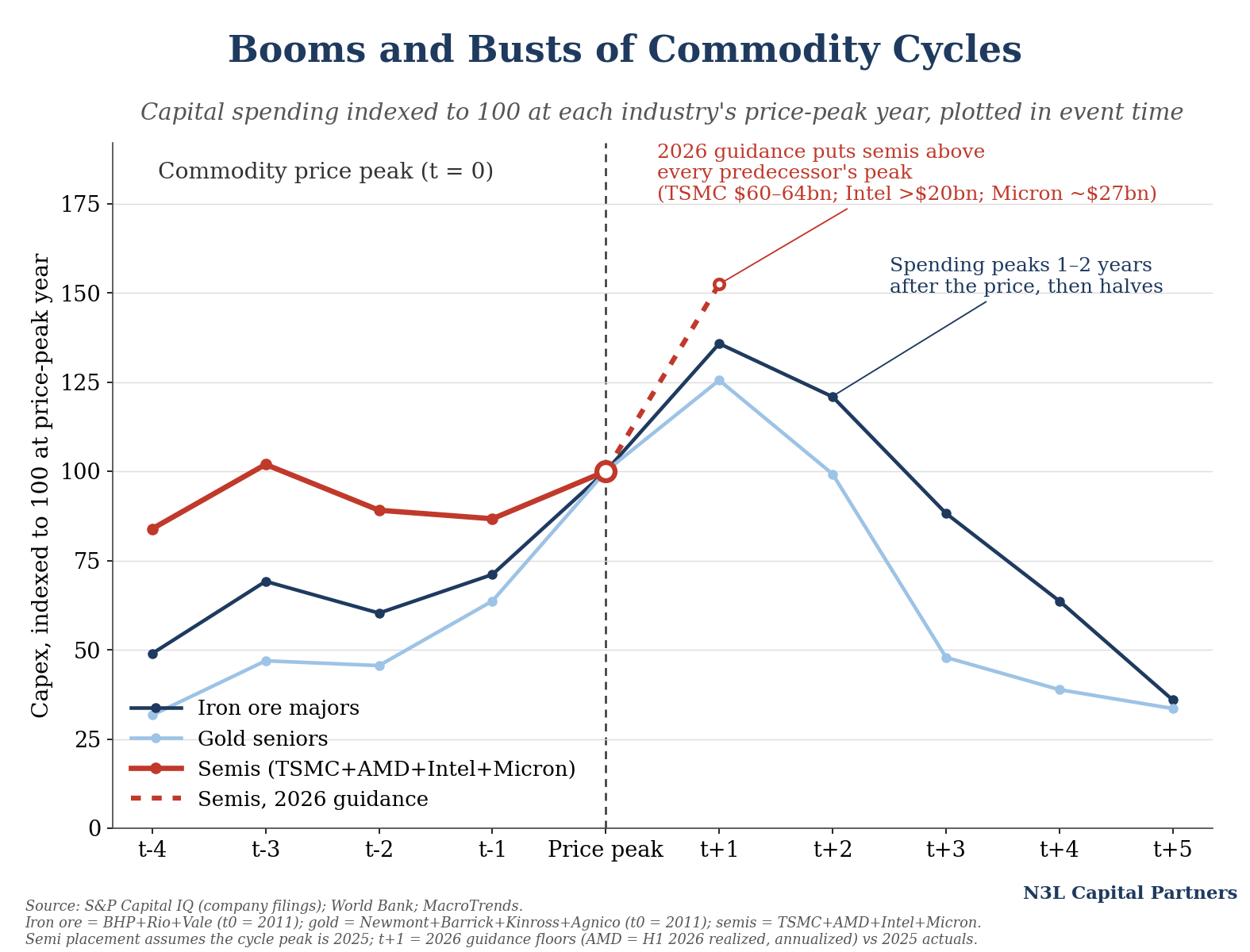
The semiconductor industry may have an identical anatomy with enormous fixed costs, a two-to-three-year lag between writing the check and shipping the wafer, and fabrication facilities that take longer to build than most mines. Currently, the whole complex is expanding at once.
Hyperscaler capex now runs above 3% of U.S. GDP, roughly triple the 1.0 -- 1.2% that telecommunications capex reached at the peak of the fiber build-out in 2000.
The objection is that this time the demand is real. It is. Internet traffic was real in 1999 too, and the fiber build-out still overshot it so badly that most of the glass laid by 2001 never carried a photon.
Maybe this is why the market reacted negatively to AMD’s BIG quarter and BIGGER capex guidance.
We’ll see!
Unless otherwise noted, information included herein is presented as of the dates indicated. N3L Capital Partners (together with its affiliates, "N3L") makes no representation or warranty, expressed or implied, with respect to the accuracy, reasonableness, or completeness of any of the information contained herein, including, but not limited to, information obtained from third parties or government sources, which may be subject to revision by the source agency or provider. Opinions, estimates, and projections constitute the current judgment of the author as of the date indicated. They do not necessarily reflect the views and opinions of N3L and are subject to change at any time without notice. N3L does not have any responsibility to update the information to account for such changes. Hyperlinks to third-party websites in these materials are provided for reader convenience only. There can be no assurance that any trends discussed herein will continue. The information contained herein is not intended to provide and should not be relied upon for accounting, legal, or tax advice and does not constitute an investment recommendation or investment advice. Readers should make an independent investigation of the information contained herein, including consulting their tax, legal, accounting or other advisors about such information. N3L does not act for you and is not responsible for providing you with the protections afforded to its clients. N3L and its affiliates may hold positions in securities, instruments, or asset classes discussed herein.
