I have written and spoken extensively about the predicament in which the U.S. fiscal and monetary authorities find themselves. To understand how we got here, read my articles about “That 70s Show” on my website: https://tomlandstreet.com/articles. There is only one way out at this point, and it involves government intervention like what we saw last weekend.
That’s when Secretary of the Treasury Scott Bessent avoided a financial market crisis by supporting the Japanese yen through purchases. Rather than selling dollars to fund the operation, he sold Euros without telling the ECB in advance. That ruffled feathers in Europe. This little action likely foretells further drama. The US has never been this indebted, and it’s been 50 years since inflation persisted.
One of modern history’s notorious financial engineers, Scott Bessent, was part of George Soros’ hedge fund team that famously shorted and broke the British pound in 1992. Sounds ruthless and clever. Now he has a new role as defender of the dollar, from villain to hero. We are watching in real time one man, one financial engineer, manage a complex global financial system to forestall disaster. The toxic combination of high and rising government debt amidst high and rising inflation creates great risk for the US government; therefore, they have little tolerance for financial system stress. The stakes are too high.
The largest foreign holder of US treasuries was about to start liquidating. When the yen reached a 40-year low recently, the Bank of Japan began intervening in currency markets by buying yen in the open market. When they ran out of cash, Japan was about to start selling treasuries to further fund its yen purchases. In comes Secretary of the Treasury Scott Bessent. The US Treasury stepped in to defend the Japanese yen for the first time since the 1998 Asian Financial Crisis.
“Wait! We got this!”
The US Treasury bought yen over the weekend to prevent them from selling treasuries. We can’t tolerate another big seller at the same time Bessent is having to refinance over $10 trillion worth of short-term federal debt within the next 12 months, all of it rolling over at sharply higher yields. See below the maturation schedule for the country’s (soon-to-be) $40 trillion in debt.
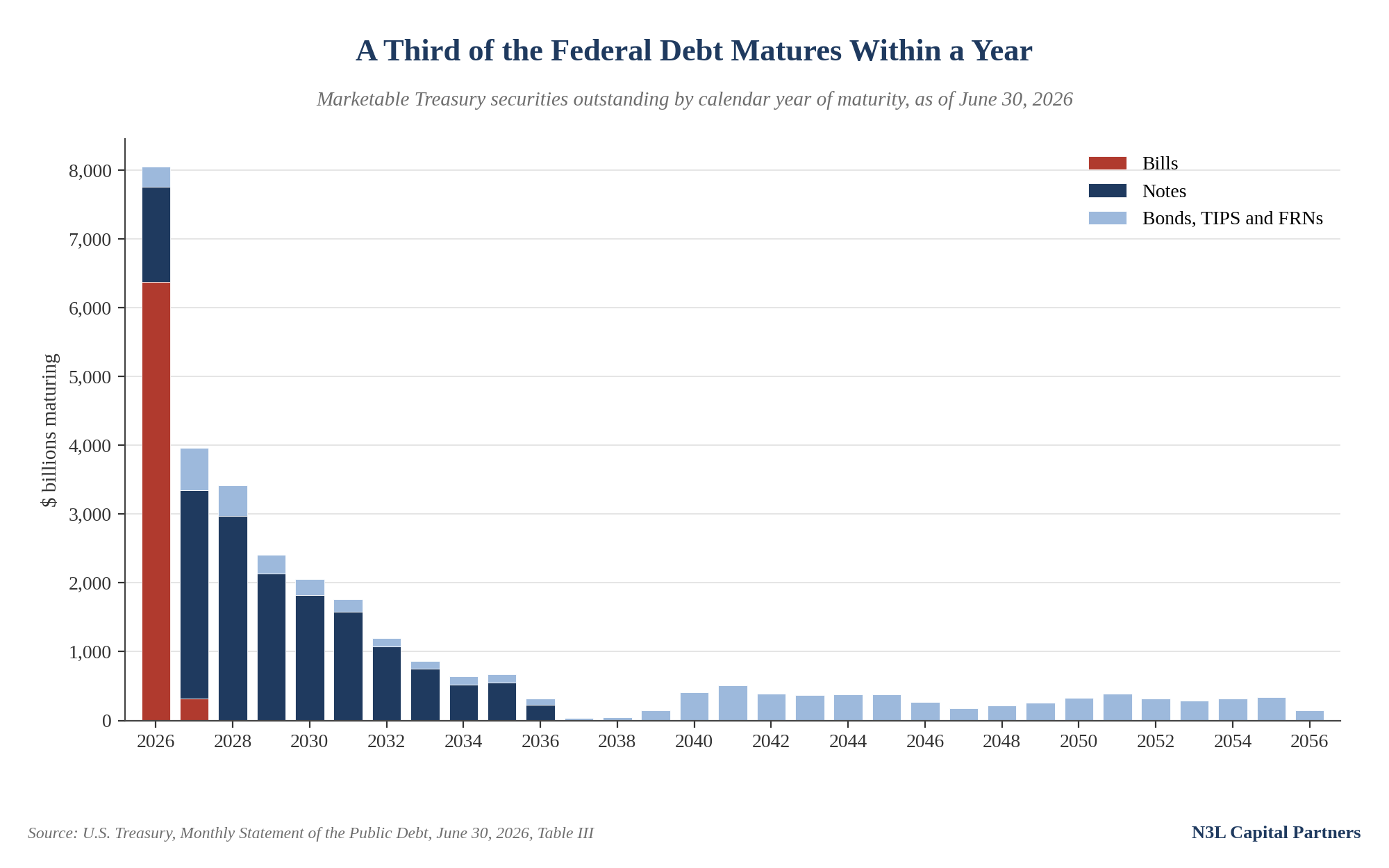
Selling Short and Buying Long: Commencing exactly one year ago, Secretary Bessent has already employed his version of yield curve control designed to keep long rates down. Because there are fewer buyers willing to lend the US money for long periods, Bessent has had to buy long-dated Treasuries. He funded these purchases by selling T-bills, which are under 2 years in duration.
The US budget deficit is inflecting higher. In November of ‘25, Bessent referred to himself as “the nation’s top bond salesman.”It will take more than a bond salesman; it will take a wizard to keep the financial system functioning as we transition this $10 trillion pile of maturing debt. Meanwhile, on Monday, the Treasury Department raised its expectations for debt issuance to $739 billion, up $68 billion from last month’s projection. Another $628 billion is projected for Q4, for a grand total of $2 trillion for the year. Adding the current debt trajectory to the higher interest rates leaves the authorities with $1.4 trillion in annual interest expense. The interest on the debt has to be paid with new debt. It seems to be spiraling.
Unfortunately, the backdrop remains unfavorable. If inflation persists, so will higher interest rates. There is no talk of cutting spending, and I don’t think Democratic Socialists are into austerity.
Call Scott Bessent’s activities fiscal policy if you like. I call it just-in-time financial engineering.
The views expressed here are those of the author and are provided for informational and educational purposes only. Nothing in this post constitutes investment advice, a recommendation, or an offer or solicitation to buy or sell any security or instrument, and nothing here should be relied upon as the basis for any investment decision. Data cited are drawn from third parties or government sources, which may be subject to revision by the source agency or provider. All opinions are as of the publication date and may change without notice. Investing involves risk, including the possible loss of principal, and past performance does not guarantee future results. Readers should consult their own financial, legal, and tax advisors before making any investment decision. N3L Capital Partners and its affiliates may hold positions in securities or asset classes discussed here.
